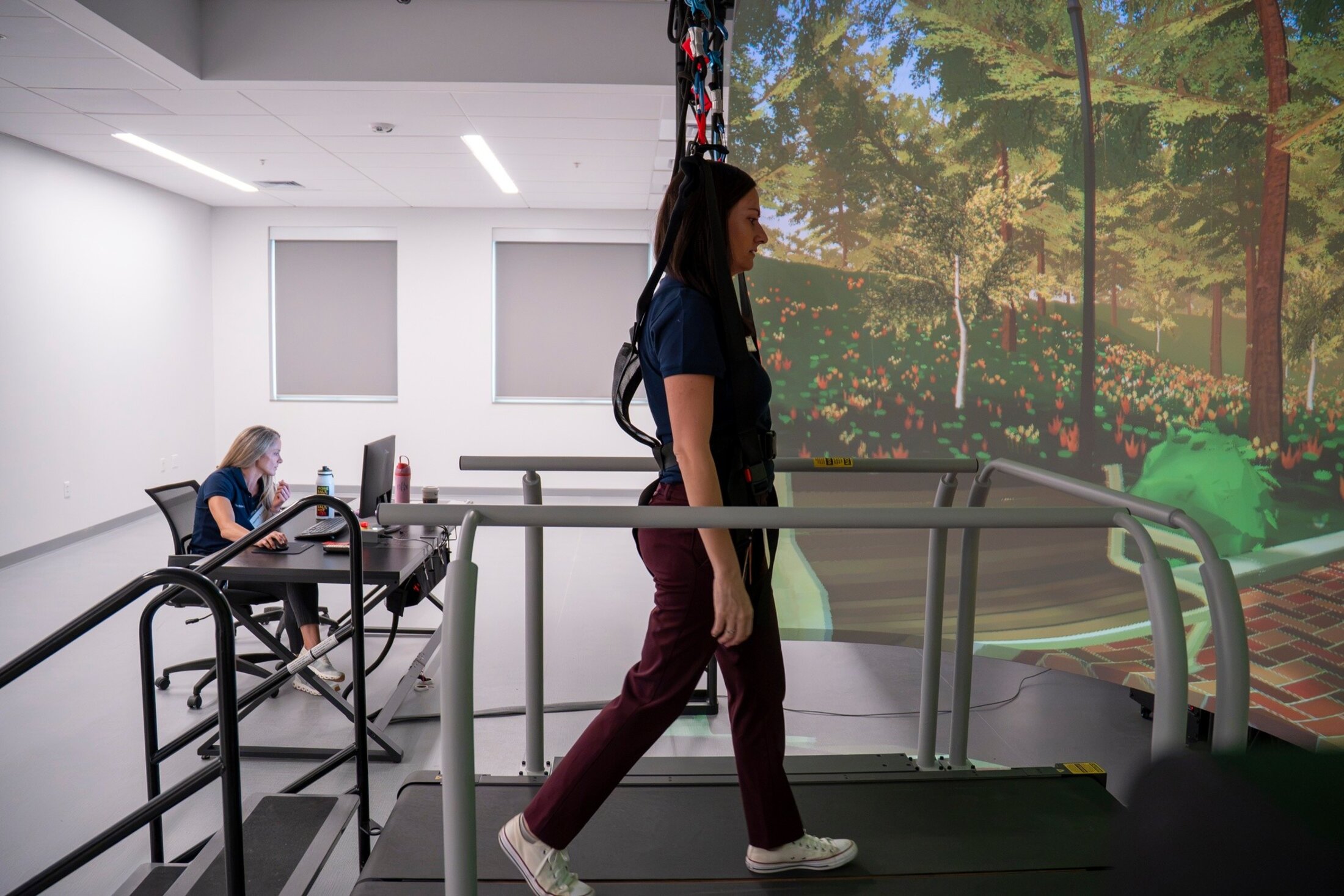
A treadmill facing a virtual landscape is part of MUSC’s effort to understand recovery after strokes and other neurological conditions. Inside its new Charleston building, researchers can study movement while participants navigate simulated surroundings.
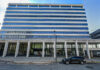
MUSC shared a new look inside the facility November 3. The 89,000-square-foot College of Health Professions building, known as CHP-D, stands at 74 President Street and celebrated its grand opening October 9.
Research that follows people into everyday life
The top two floors house the Clinical Research Center for Restoration of Neural-Based Function in the Real World, or RENEW. Its equipment includes a treadmill-based virtual-reality system, telehealth-enabled rooms and an overhead harness system paired with motion capture.
Those tools let investigators examine movement beyond a simple straight-line walk. In the harness-equipped space, researchers can measure more complex natural movements as participants move in different directions.
MUSC says the center brings together work on neural function, physical function, psychosocial function, and technology. The aim is to develop evidence that can inform rehabilitation and help people function in daily life.
A building shared by students and scientists
The university’s October opening announcement describes classrooms, simulation environments, laboratories and collaborative areas. The first four floors opened to students earlier in the year, with the upper research floors completed later.
CHP-D is the college’s fourth building. It supports education in occupational therapy, physical therapy, speech-language pathology, and health sciences and rehabilitation research, alongside professional development for practicing clinicians.
That puts students and research teams in the same building, creating opportunities for hands-on learning across disciplines. For Charleston, the expansion adds capacity to train health professionals as well as space for investigations into disability and recovery.
The funding behind the research space
The university reported at its December 2023 groundbreaking that a $7.8 million National Institutes of Health grant would support the research space. The award went to Steven Kautz, who leads the college’s Department of Health Sciences and Research.
That announcement also identified a $10 million gift from Tina and Ricky Doscher, then the largest in the college’s history. Their support included research and the college’s accessible neurological exercise and wellness program.
The new equipment supports research into how recovery happens and how to measure it. MUSC’s latest account describes that capacity and the questions researchers will study, rather than reporting the results of a new treatment trial.
For families in Charleston and the wider Lowcountry, the work centers on familiar practical goals: moving more easily, participating in community life and maintaining independence after a neurological injury or illness.